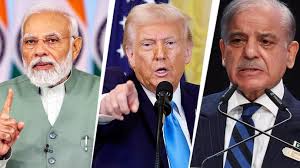
While Modi is rationalizing some tax structures, like the GST slabs, in response to the US tariffs, he now has a real chance to create a lasting legacy by bringing in massive reforms across the board.
*Ankineedu Prasad Nallapati
India-US relations are changing forever in hours from now as American penal tariffs of 50% are about to strike imports from Bharat.
Any prospects of `good sense’ prevailing? There are yet no signs of it. It all started by President Trump and he will have to make the first move. Will he extend the August 27 deadline? May be.
Everything has a shelf-life, and international relations are no exception.
Bonhomie with the West
The bonhomie with the United States has long been on decline as it swings between extreme left-wing wokism and far-right racist tendencies. Relations during the Biden administration too were under strain despite a facade of top-level contacts.
President Trump has taken the rupture to an entirely new level declaring a war on India. It’s not just about trade tariffs on Indian imports, which are currently fixed at 25%, for not opening its market for American agro and dairy products.
It’s not even about New Delhi buying oil from Russia, which led to another 25% in penalties.
What’s then bothering Trump to go whole hog against India?
He likes to be a “strong man” of dictatorial mould in line with Putin, Xi Jinping and Kim Jong Un of North Korea. He will not take “no” to his word. Like all autocrats, he is also gullible for flattery and high sounding promises.
Pakistan is good at playing dictators and has worked hard to gain access to Trump’s inner circle. Field Marshal Asim Munir dramatically nominated Trump for the coveted Nobel Prize for Peace, besides offering a free run of his country’s unproven reserves of oil and rare earth minerals.
Munir also appears to have placed his Army once again in US’s service, in support of its covert operations, financed by Gulf allies.
Islamabad has agreed to supply $ 1.5 billion worth of Chinese-made lethal weapons, including light attack aircraft, air defense systems and drones, to Sudan’s “sanctioned” ruling faction of Gen. Abdel Fattah al-Burhan, who is backed by Saudis.
Hold on. A much bigger prize, perhaps, may be on the cards.
It’s no secret that the US and Israel are engaged with Pakistani establishment to back “Abraham Accords” aimed at recognition of the Jewish state by Islamic countries. A senior Israeli officer is reportedly seen at a conference in Florida earlier this month, addressed by Munir.
In contrast, Trump sees Modi spoiling his chances of winning the much “deserving” Nobel Prize by denying him any credit in ending the recent conflict between India and Pakistan.
Modi’s polite refusal to visit the White House, while Munir was being hosted there for lunch in June, is not something a “strong man” would relish.
The Army Chief charmed Trump to believe that his best chance to win the Peace prize is to play peace maker in the India-Pakistan conflict. Trump has no clue to sub-continental geo-politics or India’s stern policy against third-party mediation.
Having lost hope of quickly ending the Russia-Ukraine war, Trump appears to be doubling his efforts to pressurize New Delhi to fall in line.
The Nobel Prize is to be announced in Norway on October 10 this year and hence the rush.
Trump’s Aide To Enforce “His Agenda”
As the tariff threats proved ineffective to change India’s stand, Trump appears to have suddenly decided to parachute his trusted `troubleshooter’ to coerce the parties to submit.
Sergio Gor, currently in charge of screening President’s political appointees, is chosen to be the Ambassador to India, and will also serve as the US Envoy for South and Central Asian Affairs.
Announcing the nomination, Trump said, “…it is important that I have someone I can fully trust to deliver on my agenda and help us MAKE AMERICA GREAT AGAIN.” Gor is a `die hard’ MAGA supporter and steadfast loyalist, who remained with Trump ever since his first term as President.
While some American experts see the appointment as a positive sign for better relations between the two countries, neither the President nor his aides have given any such impressions.
“Opportunities Multiply As They Are Seized” – Sun Tzu
Tough times never last long and the opportunities they open up hold immense treasure if they are seized in time.
Trump’s tariffs impact less than 1 % of India’s GDP and the latter can live with it, though some businesses, exposed to American economy, face hardships in the short run. India’s stock markets remained calm. Global agencies, S&P and Fitch, maintained or upgraded India’s credit ratings, discounting any major impact of the tariffs.
Trump will be in power only for another three and half years. If he is unlucky, his party may lose one or both houses of the Congress in the bi-elections next year, keeping him busy fighting internal battles for rest of his term.
Not all in the administration or the Congress are convinced of Trump’s war with India, and the latter have many friends to work with for a better relationship post-2028 election. Hence, it is important to keep engaged at different levels for longterm dividends.
The interregnum is an opportunity for India to look inside afresh at many of the old problems that had defied solution so far. These range from larger regional issues to complicated internal economic and administrative reforms.
Fresh Look At Regional Issues
China can spoil India’s rise, but can also aid its growth. It’s not easy to forget its border mischief nor a host of other issues, but it makes sense to keep engaged in frank discussions on each others’ concerns and promote understanding.
Beijing had earlier reached a conclusion that India completely tilted towards the US to China’s disadvantage, warranting a tough policy. It does not want to settle the border issue any time soon as it is the only leverage it has to hold its southern neighbour in check.
President Xi hence sees an opportunity in the current spat between India and the US to lure the former away from American influence. High level contacts have resumed and trade restrictions are easing.
India may gradually open up its market to Chinese businesses in a calibrated way to suit its growth needs while pushing for a more balanced trade relations. India has a $100 billion trade deficit with China. Each step can be conditional on progress on border settlement.
China also seems to be pressing to reactive trilateral meetings with Russia and a summit may take place on the side lines of the SCO conference in Tianjin later this month. While Beijing has its own plans, India shall use Russia to press China to resolve border issue faster.
Russia has long been a reliable and indispensable partner for India though there were strains in relations between the two, again due to perceived Indian tilt towards the US. While there is no real scope for bigger trade relations, Russia can be a major source of investments in a wide range of areas, such as defense and energy.
India may also consider responding favorably to resume back-channel contacts with Pakistan. The only plausible solution to their historical baggage is turning the Line of Control (LoC), as it exists, into the permanent border. Russia and China may be helpful, behind the scenes, without explicitly claiming any mediatory role.
It is easier said than done, but this is the direction that ultimately help India to realize its full potential to be a `great power’ and a developed nation.
Internal Reforms
Thanks to long political stability given by Modi’s BJP government that India is able to reach the level of the fourth largest economy, and just a couple of steps away from $5 trillion target that would lift it to next level.
While Modi is rationalizing some tax structures, like the GST slabs, in response to the US tariffs, he has a real chance now to create a lasting legacy by bringing in massive reforms across the board that could change the face of the country, be in political, economic or social fields.
The first and foremost requirement for such reforms is political consensus and the Modi government will have to create space for opposition parties to participate wholeheartedly. It’s not helpful to weaponize federal agencies to break the opposition. The latter also needs to extend its hand to strengthen such reforms in the greater interest of the nation.
Can Prime Minister Modi raise to the occasion? It is to be seen. If not, it’s going to be a missed opportunity.
(*Ankineedu Prasad Nallapati is the President of the Hyderabad-based think-tank, “Deccan Council for Strategic Initiatives” and former Additional Secretary to Govt of India)