Not selective or episodic narratives or highly motivated and deranged recommendations but ‘proper macro-level’ verifiable evidence is needed to berate India in matters of freedom of religion. Its absence puts question mark on USCIRF’s credibility
by Rama Rao Malladi*
It is a report that will not set on fire the Potomac River that quenches the thirst of Washington DC. Also, the Sindh River, the life-line of ‘the Land of the Pure’ as Pakistan has been styling itself right from the day it was carved out of British India as home for Muslims, most of them, Sunnis, seventy-five years ago.
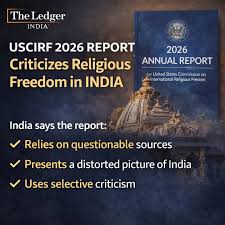
The annual cut and paste exercise of the US Commission on International Religious Freedom (USCIRF) exposes how Washington ignores the ground reality in favour of realpolitik while holding a mirror to the reality which Pakistan loves to gloss over year-after-year with unfailing regularity.
Islamophobia of the land of Ayatollahs has pricked the consciousness of the self-styled champions of religious freedom and resulted in a war that is creating nightmares to the globalised village even as victory has become a parade to nowhere amidst the ruins of the Middle East.
Naturally, the war after “Iranian Bomb” amidst fears of Doomsday in Israel is making the Gulf States to have a rethink on their dependence on the Global Cop for security cover.
If this rethink persists, it may result in a new security doctrine that factors in the American reality of not honouring its pledges and commitments, as also its calibrated attempts to make the United Nations a toothless wonder of the 21st century, will bring curtains down on the Uni-polairty while heralding multiple centers of power and power sharing.
The Religious Freedoms Report 2026 was issued on March 4 – the very day a Christian farm labourer, Marcus Masih (21) was killed in Pakistan’s Punjab province, known as the country’s cradle of power.
According to local media reports, Masih’s Muslim employers killed him and projected the murder as suicide by hanging.
Such killings are not rare in Pakistan what with Christians, Minority Shia Muslims and Hindus living in perpetual fear of Sunni Muslim vigilantes.
The Blasphemy laws, which were brought on the statute book during the regime of military rulers like Gen Zia-ul-Haq have empowered the Islam vigilantes to run a muck leaving a trail of death and destruction, and reducing Pakistani minorities to the state of stateless citizens.
The American Commission for Religious Freedoms has been religiously recording ‘vigilante violence, targeted killings, forced conversions and other religiously based crimes’ in Pakistan. Its four-point prescription, however, has no takers as yet on the Capitol Hill and the White House.
Firstly, the United States Commission on International Religious Freedom (USCIRF) wants Washington to re-designate Pakistan as a “Country of Particular Concern (CPC).”
Secondly, it calls for lifting the waiver that grants exemption to Pakistan from penalties available with the designation. Also, targeted sanctions on Pakistani officials and agencies responsible for severe violations of religious freedom. Freeze the assets of such worthies and bar their entry into the US, says USCIRF.
Thirdly, the USCIRF has asked Washington to hold accountable Pakistani officials or leaders, “who incite or participate” in crimes against religious minorities in the country.
Fourthly, the Commission has an advice to the U.S. Congress: “Incorporate religious freedom concerns into its larger oversight” of relations with Pakistan through hearings, letters, resolutions, and congressional delegations.
Christian organisations have also been highlighting the absence of freedom of religion to their fellow Christians in Pakistan.
This absence of freedom also covers conversions to Christianity.
Yet, there are reports from time to time of forced conversions and consequent vigilante dadagiri, which, the Oxford Advanced Learner’s Dictionary defines, as “the act of using strength and power to frighten or hurt weaker people.”
From all accounts, the perpetrators go around with impunity.
Sadly, the cry of Pakistani Christians has gone unheard in the corridors of power in the El Dorado of the world.
Instead, the military and civilian leadership of the country is openly courted in what is no more than a 21stcentury Laissez-faire doctrine of imperial power politics.
Lingering doubts are set to rest by the photo-ops and comradery Field Marshal Asim Munir gets in Washington as also the gift of membership to bankrupt Pakistan in President Trump’s Board of Peace for the Gaza strip.
As Uzay Bulut, a Turkish journalist and distinguished Senior Fellow at the New-York based Gatestone Institute says (in his column titled, Pakistan: Exponentiating Persecutions of Religious Minorities), Pakistan would seem hardly the most helpful member for any real “Board of Peace.”
The foregoing clearly and indisputably questions the utility of the USCIRF report vis-à-vis Pakistan.
As a corollary, the USCIRF recommendation to designate India as a “country of particular concern” is neither here nor there.
Also, its call for ‘targeted sanctions’ on the Rashtriya Swayamsevak Sangh (RSS) —the ideological parent of ruling Bharatiya Janata Party, BJP, and the Research and Analysis Wing, R&AW, India’s external intelligence agency for their alleged involvement “in violations of religious freedom.”
Obviously, the American champions of freedom of religion do not know that a vast majority of Indian media take delight in RSS bashing. Well, even of R&AW.
Put simply, ruling party status to the BJP has provided no immunity to its ‘ideological parent’.
RSS keeps getting almost on a daily basis whip lashes from India’s oldest party Congress and other political parties, which see their fortunes dwindling in election -after- election since 2014 – the year that saw the ascendency of BJP as the ruling party of India with a clear and convincing mandate.
Anyhow, India is not Pakistan.
Population of Muslims in India has increased to 14.2% (approximately 172.2 million) – up from 9.8 per cent in the days after it became independent.
In Pakistan, however, the Hindu numbers have gone down from 20-22% to 1.5-2% in the same period.
Moreover, “longitudinal evidence suggests that the overall ecosystem in India has not produced the kind of sustained demographic contraction among minorities that would ordinarily indicate systemic persecution or institutionalized exclusion”, to quote approvingly a statement of 275 eminent Indian eggheads – former judges, ex-civil servants and retired Armed Forces officers.
Not selective or episodic narratives or highly motivated and deranged recommendations but ‘proper macro-level’ verifiable evidence is needed to berate India in matters of freedom of religion. Its absence puts question mark on USCIRF’s credibility.
While on India, USCIRF will do well to desist from broad generalizations.
Anyhow, India does not need a White Man’s highly motivated prescription on ‘religious’ freedom.
India has many course correction mechanisms, some of them mandated by the Constitution itself.
And these mechanisms have withstood the test of time.
(*Rama Rao Malladi is Delhi-based senior journalist, who has vast experience of covering the subcontinental geo-politics, and is now senior analyst with the Deccan Council for Strategic Initiatives)