*by Malladi Rama Rao
Rip Van Winkles in the PMO, BJP and RSS – not necessarily in that order, though, have woken up and are walking the extra mile to build bridges with Gen -Z with an eye on the 2029 ballot since they constitute the bulk of the electorate- one out of four voters is going to be a youth, according to some projections.
History tells that Rip Van Winkle was “one of those happy mortals, of foolish, well-oiled dispositions, who take the world easy, eat white bread or brown, which ever can be got with least thought or trouble”.
Will history repeat in India?
Much depends on how the narrative is set and carried forward.
The couple of videos, reels and Instagram posts offer room for some optimism though this rollout has Sarkari stamp and thus has the potential to put off, if not everyone, at least, most of the targeted audience.
Whoever is following the graph of Narendra Modi, even if they, like Rahul Gandhi and his ilk, see him as a usurper, and are allergic to his very name, will concede that he is an astute politician with his ears to the ground. As a political communicator, he has no challenger either from within or outside.
The politician, in him, played his cards well when the government allowed the Chief Cockroach Abhijit Dipke to land at Delhi airport and then camp at the Jantar Mantar for a month.
A narrative should have been set in motion simultaneously that question paper leaks are not a new phenomenon and that government would come to grips with the issue once for all.
This did not happen.
The education minister of the day, Dharmendra Pradhan, who is a second-generation BJP-wala, should have moved upfront by refurbishing his own credentials as a one-time crusader against paper leak in his home state of Odisha. He simply retreated into a shell expecting the Modi magic wand to bail him out.
This miracle did not happen.
Instead, two developments overtook Modi and his Sancho Panzas – all because they, like the Congress, had seen the thirty -year -old Dipke as a former sidekick of AAP’s Arvind Kejriwal.
So much so, they had underestimated Dipke’s contribution to AAP’s growth and his skills as “a political communication strategist specialised in narrative building, public messaging, and moulding political opinion on digital platforms”.
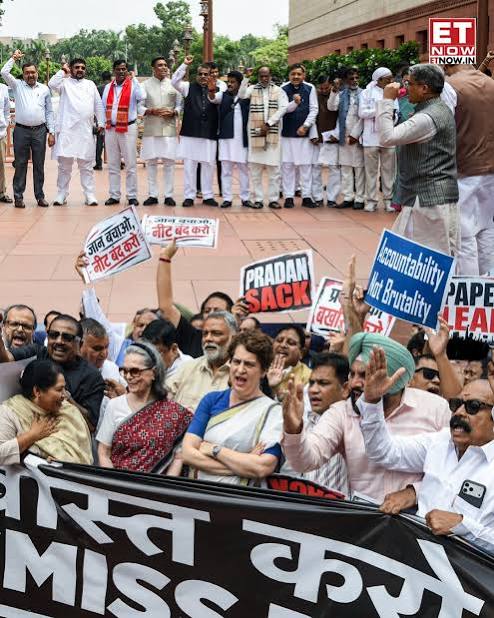
Simultaneously, the ruling dispensation allowed the Congress-Samajwadi party- TMC to literally hijack the first week of the Winter Session.
They did not seize the opening provided by the DMK, which was articulating not a paper leak issue but a TN- centric issue.
A simple strategy could have pushed the ruckus to take a back seat.
And it is asking the front benchers among the Opposition to take the floor one -after- another to voice their views.
It may be a sure invitation to a critique of the treasury benches but it could have given them a political score.
Every party, while in the Opposition, whether it is the BJP or the Congress or any other party (almost all our political parties have been on the treasury benches at least once) have a tendency to demand suspension of the Question Hour (the first item on the agenda of Parliament on any working day) by raising some issue featured on the front pages of the morning newspapers.
This exercise, in parliamentary parlance, is known as adjournment motion – adjourn the Question hour and take up discussion on our issue.
The Chair’s response to the demand generally depends on the Government, which has to face the Opposition ire.
During the week-long ruckus in Parliament, opposition adjournment motions were rejected and the very announcement increased the decibel level of protests.
Having covered both Houses of Parliament and three state legislatures, I can say that such rejection is a tactical blunder.
Rajiv Gandhi suffered a self-inflicted wound during the Bofors debate, and tamely told Parliament one day that neither he nor any one of his family had taken bribes in the gun deal. But by then the opposition had tasted blood and was gunning for the kill.
In the latest show, Narendra Modi had egg on his face – for the second time after the farm law fiasco.
His failure was compounded by the failure of the Delhi Police to engage with the Media on the very Day Force was used. The narrative slipped out of their hands notwithstanding the eagerness of the Deep Throats two days later to tell a ‘story’.
The Nadda initiative should have been accompanied by an overdrive on the Social Media/digital platforms. There was no such effort.
The best place to reduce the intensity of a brewing political crisis is the floor of Parliament.
Question Hour as the first item of the agenda is a tradition. It is not sacrosanct.
QH was suspended umpteen times in the past; if the tradition continues, will be suspended in the future too.
Rabi Ray, the socialist from Odisha, during the VP Singh regime, used to take recourse to this technique.
In fact, he had brought order to the unruly Zero Hour (a nightmare for parliamentary correspondents).
What used to be a 10 – 15-minute Zero Hour got stretched to more than an hour, and back benchers too found their voice.
Ray asked members to give him a notice of the subjects they want to raise before the House met for the day in the morning. And he used to select one topic out of a couple issues a member was interested in.
Parliament is continuing this Rabi Ray tradition even now.
General public may not know that Parliament does not have a QH when the session has an extended sitting. The proceedings begin with Zero Hour on such days.
Institutionalising the Zero Hour – euphemism for allowing members to raise issues of their concern without notice to the government – as the first item of the agenda will deprive the Opposition of a talking point.
The QH can be shifted to the post-lunch sitting if not towards the end of the sitting itself.
The Rajya Sabha tried this experiment under Vice President Ansari but gave it up after a short while without evaluating the results.
The alternative, as Rabi Ray demonstrated, is to allow the Opposition to speak on why their adjournment motion needs to be taken up.
Since the treasury benches have the numbers, they can always vote out the motion at the end of a long, absorbing debate.
The floor of Parliament, as V N Gadgil, the Congressman from the city of Peshwas (Pune), told me once, is a talking shop.
Debate will be possible, if the Politician – Rip Van Winkles in the government allow themselves to be guided by Political Instinct – not by bureaucratic allergies.
The Modis and the Shahs of the day will do well to revisit the 1963 episode of missing Moi-e-Muqqadas (a relic traditionally believed to be a hair strand of the Prophet) at the Hazratbal Shrine, Srinagar.
And take a leaf out of the political instincts displayed by Lal Bahadur Shastry, to win over the Aam Admi and to silence critics and rumour mills of the day.
(*Malladi Rama Rao is senior analyst with the Deccan Council for Strategic Initiatives. He formerly held several senior positions in the News Division of All India Radio and New Delhi-based national newspapers.)