Mixing of personal business interests with foreign policy priorities is not new to the Trump administration but the scale of new oil deals go beyond any of the previous transactions
by Prasad Nallapati*
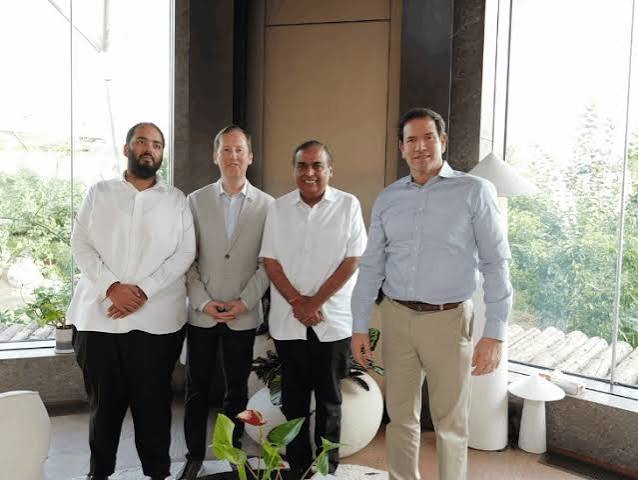
There has been lot of speculation on US Secretary Marco Rubio’s visit to Mumbai and Jamnagar (Oct 20-21) with New Delhi not being on the schedule.
In normal course, one need not read too much into it as India has a tradition of having diplomatic meetings and summits outside the capital. External Affairs Minister Jaishankar flew to Mumbai for bilateral and trilateral talks with Rubio and their UAE counterpart Sheikh Abdullah bin Zayed A Nahyan.
The attention it has received in India and abroad is because the visit is not an ordinary diplomatic trip but appears more to be part of “loaded” commercial dealings that the Trump administration has been engaged in.
Reliance Refinery and Venezuelan Oil
The Jamnagar refinery has become the key peg in the American designs of bringing the heavy Venezuelan crude into global markets, the production of which is expected to grow three-fold in next two years.
Rubio captures its role in American plans as he depicts India as a “refining superpower” and the Jamnagar complex as the “world’s largest and most complex single-site oil refinery.”
The Reliance Complex currently has a capacity to process about 1.4 million barrels of crude oil per day (bpd), including heavy, complex, and high-sulfur crude grades of Venezuela, with further scope for quick expansion.
No other country has such a scale of refining capacity of heavy crude, including China, which is otherwise the global refining superpower. It prefers cleaner, lighter and sweeter crude grades. Its Guangdong Petrochemical project, specifically designed to handle Venezuelan-grade oil, has a limited capacity of 400,000 barrels per day (b/d).
The Trump administration has grabbed control of Venezuelan oil, amounting to 65 billion barrels of proven reserves, and other mineral resources following the abduction of President Nicolas Maduro in a military operation in January and a partnership agreement signed with his successor in August this year.
According to Politico, an influential US news portal, the terms of the agreement are framed in such a way to serve American interests, without any commensurate benefits to Venezuela, through a `Board of Directors’ handpicked by President Trump.
The partner of his choice is Alejandro Betancourt, a globe-trotting Venezuelan oligarch, whose company will have complete control of production and sale of the country’s oil resources.
The Trump administration secured a 35% stake in Betancourt’s firm, North American Blue Energy Partners, by acquiring shares in a Barbados-registered parent company, at the rate of one cent ($0.01) per share.
The agreement also gives the US a discount on 20% of NABEP’s oil, in addition to the “first priority” to purchase all of the company’s remaining oil production for the next 50 years, including an irrevocable right to buy its entire oil supply in the event the US declares a national emergency.
Rubio will oversee the implementation of the agreement as part of his core responsibility toward Latin America, as per the distribution of work within the Trump administration. West Asia, China and Russia files are handled by his other Cabinet colleagues.
His Mumbai and Jamnagar visits are thus part of that role.
Talks with Reliance family in Jamnagar have not only covered the Venezuelan oil but also their partnership to set up $300 billion refinery complex in Texas, US with a capacity of 168,000 bpd.
The Venezuelan oil comes with a discount of 25% which makes it much cheaper despite high transport costs. The Russian Urals, on the other hand, is now selling at a premium, losing its earlier shine.
India imported US $ 3.5 billion worth of Venezuelan oil during April-August period this year, with over 70% being guzzled by the Jamnagar refinery alone.
Reliance Industries has long been incurring heavy losses due to past low oil prices, sanctions on Venezuela and recent West Asia crisis. A new trade deal with the US is likely to improve its margins and come out more profitable.
Commenting on the talks, President Trump stated that the U.S. and India are “pretty close” to finalizing a “much different kind of deal” than previous trade agreements.
It is to be seen what this “different kind of deal” has in it for India as it is too much to expect any beneficial treatment from the Trump administration.
US Murky Oil Deals Don’t End At Venezuela, Extends To Russia As Well
The recent deal between Presidents Trump and Putin for export of Russian diesel, ostensibly to ease `pump prices’ in the US and encourage Moscow to make peace with Ukraine, is not the end of the story.
According to New York Times, “The foreign assets of Lukoil, the Russian energy giant, are being sold off at fire sale prices because U.S. sanctions have made them nearly worthless for investors in Russia. Gas stations in the United States, refineries in Eastern Europe and oil fields around the world are up for grabs.”
It further says that some of the key figures poised to benefit from the Lukoil sale are President Trump’s family and his associates. His advisers involved in negotiations with Russia,, Steve Witcoff and Jared Kushner, are overseeing the arrangements.
The leader of the group that proposes to acquire these assets is Todd Boehly, a billionaire asset manager and big time donor to Trump’s political agenda.
Others teaming up with Boehly include one of the richest investment funds in West Asia, International Holding Company, which is overseen by Sheikh Tahnoon bin Zayed Al Nahyan, a member of the Abu Dhabi’s royal family.
Sheikh Tahnoon separately runs outfits that own nearly half of World Liberty Financial, the cryptocurrency company co-founded by Witkoff and is still run by his son Zach Witcoff.
Donald Trump Jr, and Barron Trump, two of the President’s sons, are also stakeholders and co-founders of the company, making them effectively business partners with Sheikh Tahnoon.
The Emirati mogul is also associated with the private equity firm, Affinity Partners, which was set up by Kushner, the President’s son-in-law.
Boehly’s other associates, Syrian-born Qatari billionaires, Moutaz Al-Khayyat and his brother Ramez Al-Khayyat, are also partnered with Kushner and his wife, Ivanka Trump to build a multibillion-dollar resort complex planned for the Mediterranean coast of Albania.
Mixing of personal business interests with foreign policy priorities is not new to the Trump administration but the scale of these deals go beyond any of the previous transactions involving his family and friends.
(*Prasad Nallapati is President of the Hyderabad-based think-tank, “Deccan Council for Strategic Initiatives”, and former Additional Secretary to the Govt of India)